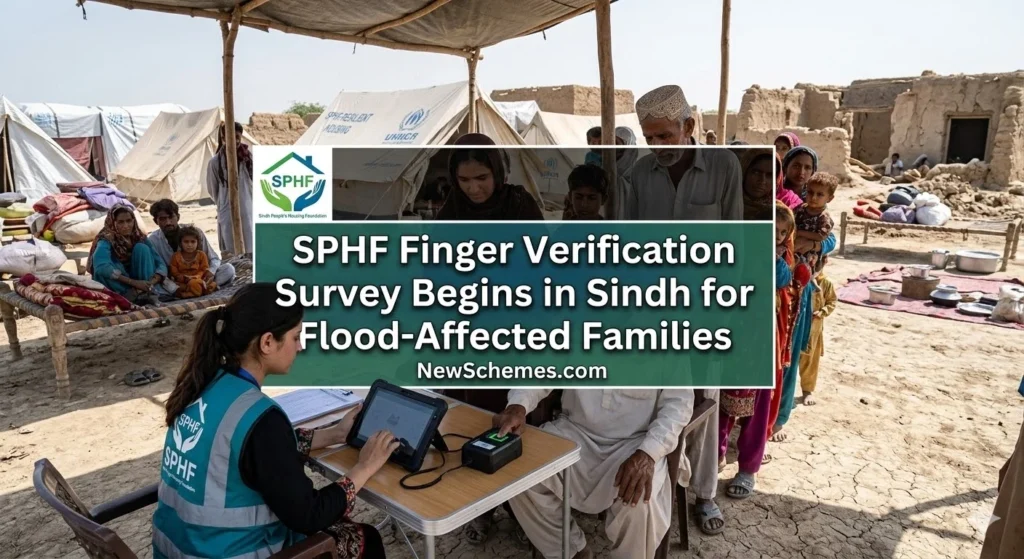
SPHF Finger Verification Survey Begins in Sindh for Flood-Affected Families
SPHF Finger Verification Survey Begins in Sindh for Flood-Affected Families, The Government of Sindh has officially launched the fingerprint verification survey under the Sindh Peoples Housing for Flood Affectees (SPHF) program to verify beneficiaries and ensure transparency in the housing reconstruction initiative for flood-affected communities. The survey is an important step to confirm the identities of eligible families who were previously registered for housing assistance after the devastating 2022 Pakistan Floods.
The verification process is being conducted across multiple districts of Sindh where thousands of homes were damaged or completely destroyed during the floods. Through biometric fingerprint verification, authorities aim to ensure that financial assistance reaches the genuine beneficiaries.
Background of the SPHF Housing Program
The Sindh Peoples Housing for Flood Affectees program was established by the Government of Sindh to rebuild homes for families who lost their houses during the 2022 floods. The floods were one of the worst natural disasters in Pakistan’s history, affecting millions of people and causing widespread destruction across the province.
According to official data, more than 2 million houses in Sindh were either damaged or destroyed during the floods. To address this crisis, the provincial government launched a large-scale housing reconstruction program aimed at helping families rebuild safer and stronger homes.
The initiative is being implemented with financial and technical support from international development partners, including the World Bank. The program focuses on building disaster-resilient homes that can better withstand future climate-related events.

Purpose of the Fingerprint Verification Survey
The main purpose of the fingerprint verification survey is to authenticate the identity of beneficiaries who were previously registered during damage assessment surveys. While initial surveys collected data on affected households, biometric verification ensures that the assistance is provided only to the rightful recipients.
By using fingerprint technology, the government aims to prevent fraud, duplicate registrations, and misuse of housing funds. The verification process helps ensure fairness and transparency in the distribution of financial support.
Officials have stated that biometric verification will also create a reliable digital record of beneficiaries, making it easier to track progress and monitor the distribution of funds.
How the Verification Process Works
The fingerprint verification survey is being carried out by trained survey teams across flood-affected districts. Beneficiaries are required to present their Computerized National Identity Card (CNIC) during the verification process.
The steps involved in the process include:
- Verification of the beneficiary’s CNIC and personal details.
- Fingerprint scanning through biometric devices.
- Matching the biometric data with the SPHF database.
- Confirmation of eligibility for housing reconstruction assistance.
Once a beneficiary successfully completes the verification process, their record is updated in the system and they become eligible to receive financial installments for rebuilding their homes.
Click And Check
Housing Assistance for Flood Victims
Under the SPHF program, verified beneficiaries receive financial grants to rebuild their homes. The funds are usually provided in multiple installments, allowing families to gradually complete the construction of their houses.
The housing reconstruction program also provides technical guidance on safe construction practices. Communities are encouraged to follow improved building standards to ensure homes are stronger and more resilient to floods and other natural disasters.
The initiative also promotes community participation, with local workers and engineers helping families rebuild houses according to approved designs.
Survey Coverage Across Sindh
The fingerprint verification survey is being conducted in several flood-affected districts across Sindh. Mobile teams and local authorities are working together to reach remote villages where many affected families still live.
Verification centers have also been established in different locations to facilitate beneficiaries. These centers allow registered families to complete the biometric process quickly and receive confirmation of their eligibility.
Local administrations are coordinating with community leaders to inform residents about the verification schedule and ensure that all eligible beneficiaries participate in the process.
Ensuring Transparency and Accountability
Officials from the Government of Sindh have emphasized that the fingerprint verification system is essential for maintaining transparency in such a large-scale housing program.
Biometric verification helps eliminate duplicate entries and ensures that each beneficiary receives assistance only once. The system also allows authorities and development partners to monitor the program more effectively.
By maintaining accurate records, the government can ensure that housing funds are distributed fairly and efficiently.
Conclusion
The fingerprint verification survey launched under the Sindh Peoples Housing for Flood Affectees program represents a significant step in the rebuilding process following the devastating 2022 Pakistan Floods. Through biometric verification, the Government of Sindh aims to ensure that housing assistance reaches the families who truly need it.
As the verification process continues across Sindh, thousands of flood-affected households are expected to receive the support necessary to rebuild their homes and restore stability to their lives. The initiative not only provides shelter but also offers hope for communities recovering from one of the most severe disasters in recent history.